

How to Find the Sources AI Assistants Cite in Your Category
BY DZAN VOLODER, FOUNDERLAST UPDATED 7 MIN READ
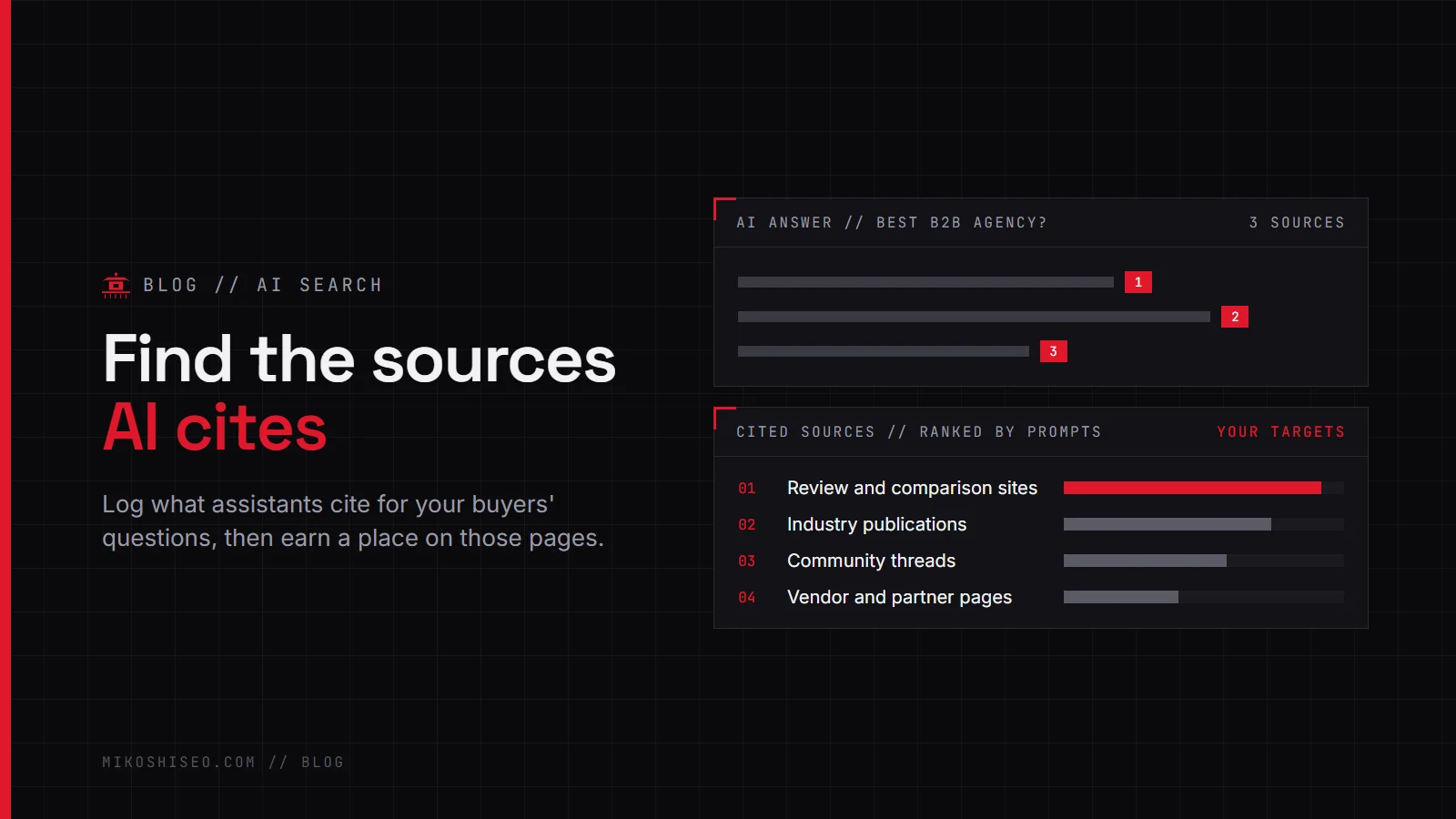
Run your buyers' real questions through assistants that show their sources, log every cited page, group the pages by type and rank the domains by how often they appear. The domains cited most in your category are where your brand needs to be present: through reviews, listings, expert contributions or partner pages.
Why cited sources are the shortcut
Assistants that search the web show where their answers come from. Perplexity numbers its citations on every answer, Google's AI Overviews and AI Mode link to supporting pages, and ChatGPT search uses its own crawler to find pages it can show and link.
That list of sources is a map of whom the assistants trust in your category. Getting your brand onto pages that are already cited is usually faster than waiting for your own site to become a source.
Step 1: build a prompt set your buyers would really use
Write 20 to 50 prompts with your sales team. Mix four kinds: category prompts ("best B2B payroll software for 200 employees"), comparison prompts ("Brand A vs Brand B"), problem prompts ("how to cut payroll errors across three states") and local or segment prompts ("payroll providers for US startups"). Leave your own brand name out, or you only measure how you are described, not whether you are found.
Step 2: collect the citations
- Run every prompt in Perplexity, ChatGPT with search on, Gemini and Google, where an AI Overview or AI Mode answer appears.
- Record each cited URL, its domain, the prompt, the assistant and which brands the answer named.
- Run each prompt at least three times. Answers vary a lot between runs, so one run shows you an anecdote, not a pattern.
- Use a clean browser profile or private window, so personal history does not shape the answers.
Step 3: log it in one simple table
A spreadsheet is enough. One row per citation keeps the counting honest and makes the next step a simple pivot table.
prompt,assistant,run,cited_url,domain,source_type,brands_named
"best B2B SEO agency for SaaS",Perplexity,1,https://reviews.example.com/top-seo-agencies,reviews.example.com,Review site,"Agency A; Agency B"
"best B2B SEO agency for SaaS",Perplexity,2,https://magazine.example.org/seo-agencies-2026,magazine.example.org,Publication,"Agency B; Agency C"
"Agency A vs Agency B",Google AI Overview,1,https://forum.example.net/thread/4821,forum.example.net,Community,"Agency A; Agency B"
The domains above are illustrative examples. In a real log you will quickly see the same 10 to 20 domains come back across many prompts.
Step 4: group the sources by type
- Review and comparison sites. Directories, software and agency review platforms and "best of" listicles. Get listed with an accurate profile and earn genuine reviews.
- Industry publications. Trade media, newsletters and analyst blogs. Pitch expert commentary, original data or a useful guest article.
- Community threads. Forums, Q&A sites and professional groups. Take part as a named expert and answer the question asked, rather than posting links.
- Vendor and partner pages. Integration directories, partner listings and customer pages. Ask partners to describe you accurately and link to you.
- Your own site and your competitors' sites. Note which of your pages are cited, and which competitor pages win, then compare the page types and formats.
Step 5: rank the domains and make a plan
Count how many different prompts cite each domain, not how many times it appears, so one long thread does not distort the picture. Take the top ten, and for each one write down how your brand could earn a presence there, who owns it and a target date.
Prioritise sources that appear across several assistants and several prompts. Those are the ones that shape your category's answers most broadly.
What not to do
- Do not buy reviews or write them yourself. In the US, the FTC's 2024 rule bans buying or selling fake reviews, including AI-generated ones, with civil penalties for knowing violations.
- Do not post promotional links in communities. Moderators remove them, and members remember the brand that did it.
- Do not chase every domain. Twenty strong placements beat two hundred thin ones.
How often to repeat it
Re-run the same prompt set every month for visibility, and redo the full source analysis every quarter. Cited sources shift as new articles are published and old ones age, and your plan should shift with them.