

robots.txt for AI Crawlers: Which Bots to Allow (2026 List)
BY DZAN VOLODER, FOUNDERLAST UPDATED 9 MIN READ
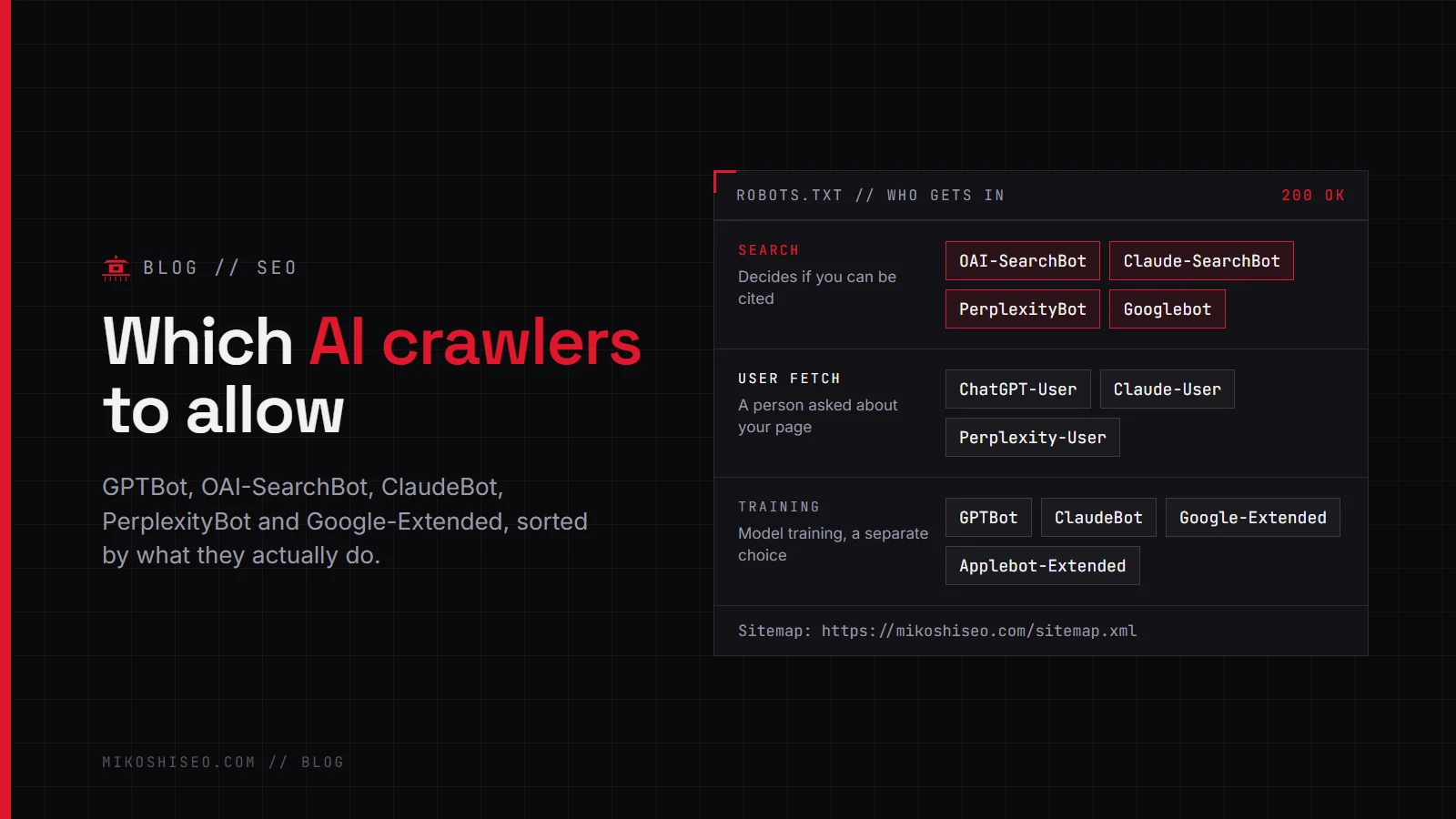
If you want to be cited in AI answers, allow the AI search crawlers: OAI-SearchBot for ChatGPT search, Claude-SearchBot for Claude, PerplexityBot for Perplexity and Googlebot for Google's AI features. Training crawlers and tokens, such as GPTBot, ClaudeBot, Google-Extended and Applebot-Extended, are a separate decision: blocking them keeps your content out of model training without removing you from search.
What is an AI crawler?
An AI crawler is a bot run by an AI company that fetches web pages, either to build a search index its assistant can cite, to answer a question a user just asked, or to collect training data for future models. Each one identifies itself with a user agent name, which is what robots.txt rules match against.
For a deeper look at how these bots behave, how to spot them in your logs and how to tell real ones from fakes, see our guide to AI crawlers.
Three kinds of AI bots
Most confusion about AI crawlers comes from treating them as one group. They do three different jobs, and each AI company publishes separate names for them.
- Search crawlers. OAI-SearchBot, Claude-SearchBot and PerplexityBot build the indexes their assistants search when they answer. Blocking them can keep you out of those answers.
- Training crawlers and tokens. GPTBot and ClaudeBot collect content that may be used to train models. Google-Extended and Applebot-Extended do not crawl at all: they are robots.txt tokens that control how content Googlebot and Applebot already fetched may be used for AI.
- User-request fetchers. ChatGPT-User, Claude-User and Perplexity-User visit a page because a person asked about it. OpenAI and Perplexity both say these fetches may not follow robots.txt, because a user started them.
Company by company
- OpenAI. OAI-SearchBot decides whether you can appear in ChatGPT search answers. GPTBot is the training crawler. OpenAI states that each setting is independent, so you can allow search and block training.
- Anthropic. Claude-SearchBot indexes pages to improve search results, Claude-User fetches pages for user questions and ClaudeBot collects training data. Anthropic says blocking the search and user agents may reduce your visibility in Claude.
- Perplexity. PerplexityBot surfaces and links websites in Perplexity results, and Perplexity states it is not used to crawl content for AI foundation models. Perplexity-User fetches pages when a user asks.
- Google. AI Overviews and AI Mode use the regular Search index crawled by Googlebot. Google-Extended controls whether your content is used to train Gemini models and for grounding in Gemini Apps, and Google states it does not affect inclusion or ranking in Google Search.
- Apple. Applebot powers results in Spotlight, Siri and Safari. Applebot-Extended only controls whether crawled content is used to train Apple's foundation models; pages that disallow it can still appear in search results.
Other AI crawlers worth knowing
- Amazon. Amazonbot improves Amazon products and may be used to train Amazon AI models. Amzn-SearchBot supports search experiences such as Alexa, and Amzn-User fetches pages for a user's request; Amazon says neither is used for generative AI training, and that Amzn-User may not follow every robots.txt rule.
- Mistral. MistralAI-Index builds the index behind Mistral's search, MistralAI-User fetches a page to answer a user and links to it, and MistralAI-Training collects data for model training. Only the training agent is used for training.
- DuckDuckGo. DuckAssistBot fetches pages in real time for DuckDuckGo's AI-assisted answers, which show their sources. DuckDuckGo says the data is not used to train AI models and that it respects robots.txt.
- Common Crawl. CCBot builds Common Crawl's open web archive, which anyone can download and analyse. Common Crawl publishes a robots.txt rule to opt out, and warns that other bots sometimes pretend to be CCBot.
What we chose for mikoshiseo.com, and why
For a B2B brand that wants to be recommended, visibility usually outweighs concerns about training. Our robots.txt allows every major search engine, AI search crawler, user-request fetcher and training crawler, and points to our sitemap. This is the structure, trimmed:
# AI search and citation indexes
User-agent: OAI-SearchBot
User-agent: Claude-SearchBot
User-agent: PerplexityBot
Allow: /

# Fetches made when a person asks an assistant about a page
User-agent: ChatGPT-User
User-agent: Claude-User
User-agent: Perplexity-User
Allow: /

# AI model training and AI product use
User-agent: GPTBot
User-agent: ClaudeBot
User-agent: Google-Extended
User-agent: Applebot-Extended
Allow: /

User-agent: *
Allow: /

Sitemap: https://mikoshiseo.com/sitemap.xml
If you want to stay visible in AI search but keep your content out of model training, change only the training group to Disallow: /. Leave the search crawlers and Googlebot allowed.
Check that it actually works
- Open yoursite.com/robots.txt and confirm it loads as plain text with a 200 status.
- Check your CDN or firewall bot settings. Some block AI user agents by default, even when robots.txt allows them.
- Look for the AI user agents in your server or CDN logs to confirm they reach your pages.
- Make sure key content is in the HTML. Most AI crawlers do not run JavaScript.
- Keep the Sitemap line, so every crawler can find your pages.