

What Is an AI Crawler? How AI Bots Read Your Website
BY DZAN VOLODER, FOUNDERLAST UPDATED 7 MIN READ
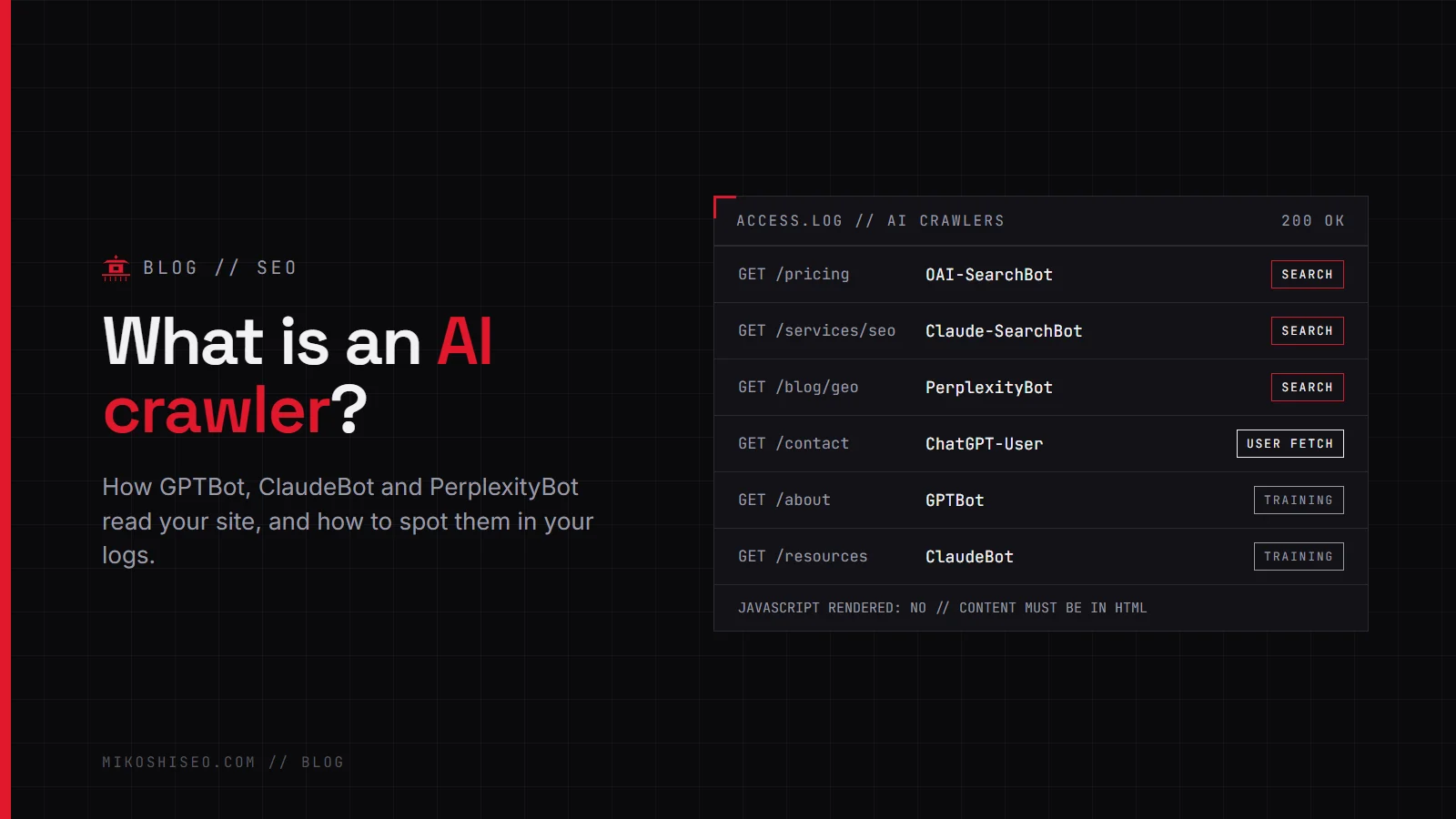
An AI crawler is a bot run by an AI company that fetches web pages for one of three jobs: building a search index its assistant can cite, answering a question a user just asked, or collecting training data. Most do not run JavaScript, they identify themselves by user agent, and the main ones publish how to control them with robots.txt.
What an AI crawler does
AI companies run several bots, each with its own name and job. Knowing which job a bot does tells you what allowing or blocking it means for your business.
- Search indexing. Bots such as OAI-SearchBot, Claude-SearchBot and PerplexityBot build the index an assistant searches when it answers. This is what decides whether you can be cited.
- User requests. Bots such as ChatGPT-User, Claude-User and Perplexity-User fetch a page because a person asked about it. OpenAI and Perplexity say these may not follow robots.txt, because a user started them.
- Training. Bots such as GPTBot and ClaudeBot collect content that may be used to train future models.
How AI crawlers differ from Googlebot
Googlebot renders pages with JavaScript before indexing them. Most AI crawlers do not: Vercel's analysis of crawler traffic found that none of the major AI crawlers render JavaScript. If your key content only appears after scripts run, AI crawlers may see an empty page while Google sees the full one.
This is the single most common technical reason a site ranks in Google but is never cited by AI assistants. Serve key content in the initial HTML, through server-side rendering or pre-rendering.
How to find AI crawlers in your logs
Your hosting provider or CDN keeps access logs with a user agent for every request. Search them for the AI crawler names to see which bots visit, which pages they fetch and how often.
grep -Ei "GPTBot|OAI-SearchBot|ChatGPT-User|ClaudeBot|Claude-SearchBot|Claude-User|PerplexityBot|Perplexity-User|Amazonbot|DuckAssistBot|MistralAI|CCBot" access.logLook for patterns: which pages search crawlers fetch most, whether they reach your service and pricing pages, and whether any of them get errors.
How to tell real bots from fakes
Anyone can send a request that claims to be GPTBot or Googlebot. Common Crawl, for example, warns that other bots sometimes pretend to be CCBot. Before you trust, block or rate-limit traffic by user agent, verify it.
For Google, run a reverse DNS lookup on the IP address, check that it ends in googlebot.com, google.com or googleusercontent.com, then confirm with a forward lookup, or match the IP against the ranges Google publishes. OpenAI and other AI companies also publish the IP addresses their crawlers use.
What this means for your site
- Put your key content in the HTML, not only in JavaScript.
- Allow the AI search crawlers you want to be cited by in robots.txt.
- Check that your CDN or firewall does not block them by default.
- Keep a sitemap and link to it from robots.txt.
- Review your logs monthly to confirm the crawlers reach the pages that matter.